
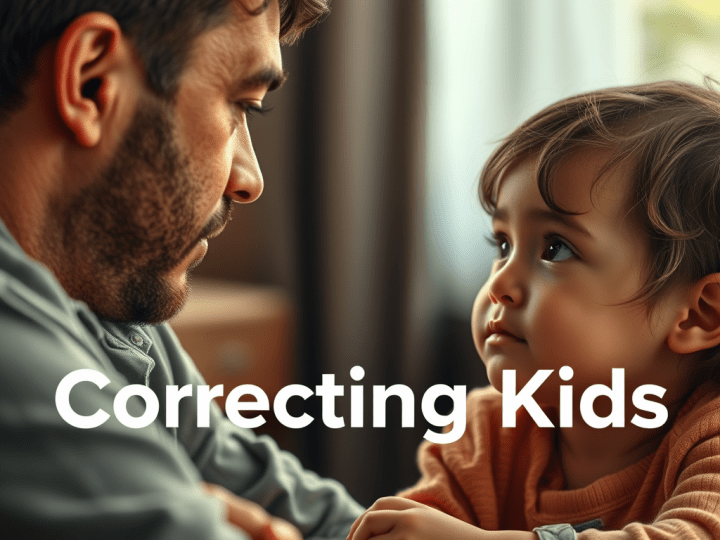
When a Child Corrects You: Accountability, Respect, and Grace
Recently, a child corrected me.
I work with kids for a living so this is not a new thing for me. As the old saying goes ” Kids say the darn’est things”. But then after this initial incident my own kid corrected an adult and I had to firmly tell her that it was not her place. But was it?
And while they were both technically right—the experiences brought up a topic that often is not talked about when raising kids. For both situations, It didn’t land how I hoped, and instead of softening, I dug in even deeper. Not because I thought I was right, but because the correction’s came publicly, without grace, and from children who had no context for where the adults were emotionally or mentally.
That moment (for me) followed one of the worst days and nights I’d had in a while—something the child that corrected me didn’t know, and didn’t need to. It is not the responsibility of a kid to know these things. That’s on the adults and shouldn’t be an excuse.
Still, the correction stung. And I didn’t feel my kid corrected the adult she did with kindness or thought. SO…
When Can a Child Correct an Adult?
I was wrong for saying what I said in front of the child. The adult my kid corrected was also wrong, but the correction was not done tactfully or respectfully and we all know two wrongs do not make a right. It’s a hard question. When—if ever—is it appropriate for a child to correct an adult? And how?
Part of what made me bristle in my own experience was my strong belief in respecting elders. I believe in honoring the roles God places us in—parent, teacher, child, student—and that humility is essential for both giving and receiving correction. That said, we also want our children to grow in righteousness, advocate for truth, and have a voice. No matter how young a person is. It’s never ease to swallow when you make mistakes, but how do we walk this out well and how do we teach children not to judge people so quickly?
But how do we help them do that in a way that’s both biblical and respectful? When can a kid correct if ever? And How?
Where’s the line between judgment and accountability?
Jesus warns us in Matthew 7:1–5 not to judge. But Paul, in Galatians 6:1–5, tells us to gently restore those caught in sin. So how do we teach accountability without slipping into judgment, especially within our families?
What We Teach in Our Home
In our family, we have some guiding principles—many rooted in Scripture and refined through our own trial and error. Here are the main ones:
1. Correction Should Build Up, Not Tear Down
(Galatians 6:1–2)
Paul reminds us to restore others “gently.” Correction is meant to uplift, not condemn. Accountability shouldn’t feel like a public flogging—it should feel like an act of love. Our goal is always restoration and connection, not punishment or embarrassment.
Where’s the line between judgment and accountability? Jesus clearly warns us to be cautious of the first (Matthew 7:1–5), but Paul calls us to seek out and practice the second (Galatians 6:1–5).
Our main focus as a family in This area of correction is: In Galatians 6, where Paul focuses on building up others. Many people are quick to correct and label it as “accountability”. Few people are willing to turn the other cheek, show compassion, or as Paul says, for building up!
Our number two thing in this arena is that everyone in this world has value and they deserve respect!
2. Respect Is Foundational
Everyone has value. Everyone deserves respect. This is a core value in our home—especially when correction is involved.Before correcting, we ask:
Are we prioritizing being right over staying connected?
Are we judging someone without knowing their story?
Are we speaking respectfully?
3. Respect the Roles
Every relationship has a structure. Adults should be respected as elders and guides; children should be respected as learners. When these roles are reversed, it creates dysfunction.
Children correcting adults regularly—especially without relationship or permission—can lead to what psychology calls adultification, and often fosters premature judgment without understanding.
For example, my children know:
- They can speak into my or my husband’s life, respectfully.
- They cannot correct their grandfather or teacher without permission or relationship.
It’s not about age—it’s about authority, relationship, and discernment.
Without the relationship (like Jesus had with his disciples) we personally have decided to not correct. They walk away and let God. Another example is my father has given me permission to speak into his life, despite being his child. But my kids know they do not have that privilege or permission to do so yet! It has nothing to do with age, but with relationship. That’s their grandfather and I will remind them, if they step out of line.
4. Correction Needs Planning and Grace
Correction often triggers emotional responses—defensiveness, shame, anger. That’s why it’s rarely effective when it’s blasted out publicly. We plan correction when possible and teach our kids to do the same.
If they need to correct someone, here’s the approach:
- Listen first (even if you disagree).
- Then ask: “Can I say something?”
- Speak gently. If it’s not the right moment—walk away and let God work.
Matthew 18:15 reminds us: correction should be done privately. Public confrontation often has more to do with pride than love.
If something is being said from the adult, it is always a “yes ma’am or yes sir”. Listen first!! Then a “can I say something?” I want my kids to have a voice and be advocates for righteousness but there is a time and place and often we miss this if we do not tread carefully. The book of Timothy tells us to not be discouraged because of our youth” (1 Timothy 4:12) My kids know what the Bible says about accountability but also that without regular relationship or explicit permission from the individual to correct someone they just need to walk away. Because now we are just judging and labeling it something else entirely. Sometimes in this type of situation it is a “No, they cannot say something.” For example: they can talk to someone about misconduct but not publicly! Ever! This is a pious Pharisees show of an “Im better” attitude and going to call you out to humiliate and embarrass. We do not believe this is biblical (go to your brother privately(Mathew 18:5) That’s why Paul was quick to point out that it needs to be delivered “in a spirit of gentleness” (Galatians 6:1). And the manner in which it is delivered is often what separates accountability from judgment. This disagreeing skill keeps everyone feeling understood. And it also keeps them from correcting their grandfather or a teacher who they do not have permission to speak into!
We as the parents/adults have taught and continue to teach our children what words to say to correct someone. They also know what the correction is going to be for certain things if they choose to do something in the wrong. This is done With Grace – deep grace, and some gumption (if needed) for it is a hard role to play. If they can’t correct in this way, the corrector is in the wrong. And now we have a plank in our own eye. (Mathew 7:3)
In our family, we have a skill set the children know that keeps the roles in the proper alignment, but allows them to still correct adults (if needed.)
5. Avoid Excuses—Choose Humility
Correction is never easy to give or receive. It requires humility on both sides. We remind our kids: don’t make excuses. Just because someone disagrees doesn’t mean they’re wrong—and vice versa.
In Christian circles, people love to throw around Scripture and theology. But without humility, correction just becomes spiritual arrogance. It is a hard pill to swallow and the objective in correction is for someone to actually hear you! If you close someone off by saying something and you shut the relationship down have you actually brought them back in or pushed them further away? I tell my children (and myself) that humility is the way instead of taking the path to pride — which is paved with excuses and irresponsibility on both sides! It is so so hard but it is better for all in the long run because it brings people back to Jesus and it keeps our minds open to the possibility that maybe we are misrepresenting something too.
The goal is not to win a debate—it’s to bring people closer to truth and to Jesus.
6. If They’re Not Open, Let It Go
Sometimes, even when we speak truth, the other person isn’t ready to receive it. That’s okay.
Once you’ve spoken gently and in love, the rest is up to God. “Vengeance is mine,” says the Lord (Romans 12:19).
If someone is too emotional or unwilling to listen, walk away. Let God handle it. Correction should never break a relationship if it’s done right.
Understanding the persons story will help not villainize each other. This is a great reminder when the sibling rivalry is going on – about who is right and who is wrong.
Final Thoughts
These practices aren’t perfect—and we’re still in the messy middle of parenting and walking out our faith. But they’ve helped us navigate hard moments in a way that fosters growth instead of division.
Correction isn’t easy. It’s not supposed to be. But it doesn’t have to be damaging either.
With grace, patience, and God’s wisdom, we can help our kids (and ourselves) correct well—without judgment, pride, or harm.
The tone that accompanies this should be goodness of the other person as TOP priority! (Remember sometimes sharpness is good!) A calmness too is demonstrating that this moment isn’t a bad moment, but a good one.
A Resource I’m Loving
I’ve just started reading Supercommunicators by Charles Duhigg. It’s full of practical, insightful tips on how to communicate well—even in high-stakes, emotional moments. I highly recommend it for anyone looking to grow in this area!


 Creating Exceptional